Edited Volumes and Special Issues
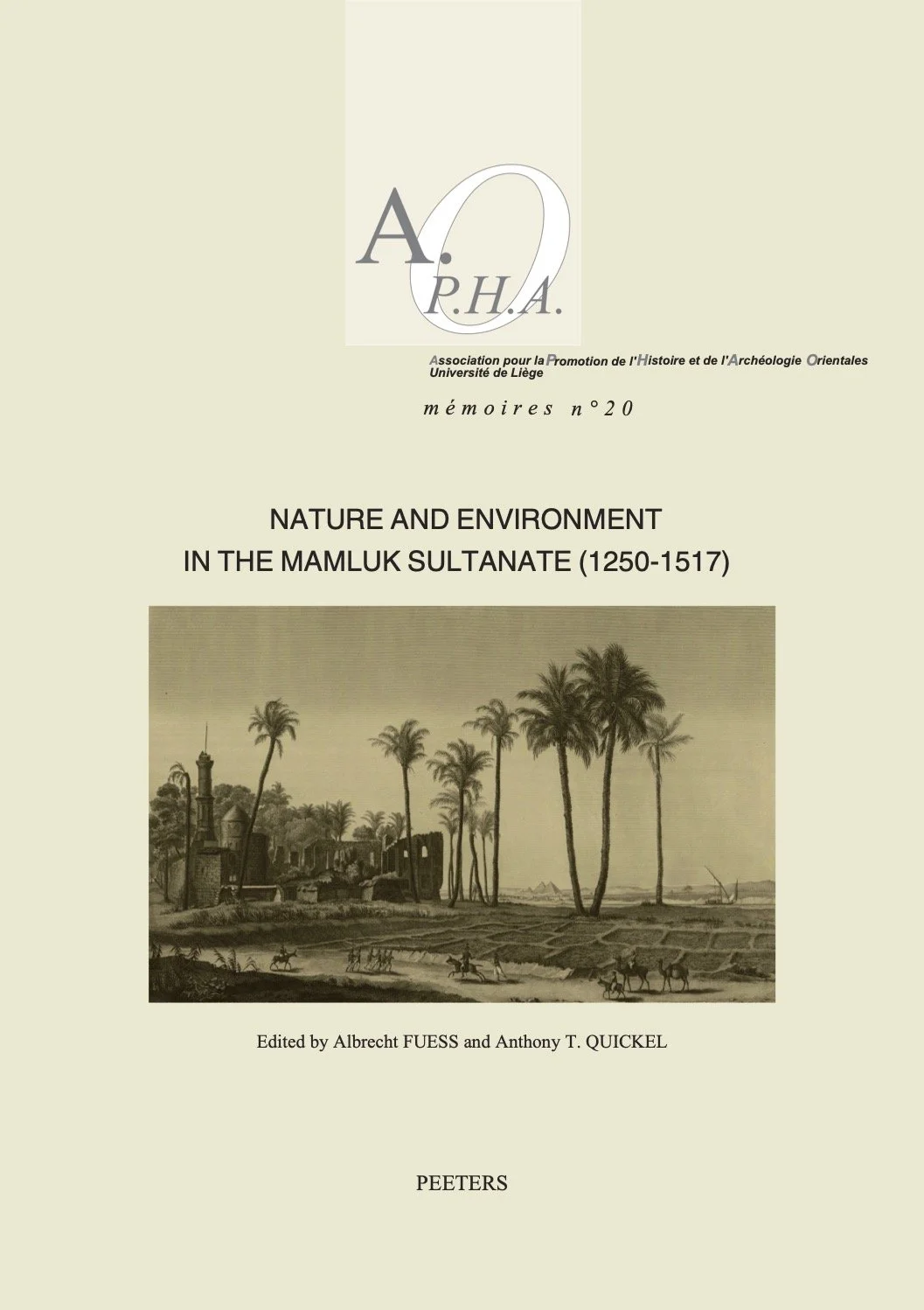
Edited with Albrecht Fuess, Nature and Environment in the Mamluk Sultanate (1250-1517), Series Mémoires de l’Association pour la Promotion de l’Histoire et de l’Archéologie Orientales (Leuven: Peeters Publishers, Forthcoming 2026).
This volume brings environmental history into sustained dialogue with the cultural, legal, and intellectual worlds of late medieval Egypt. Moving beyond irrigation systems and agricultural production alone, the volume explores how animals, landscapes, substances, and natural forces were imagined, regulated, and mobilized in Mamluk society. The contributions approach environment as both a material reality and a field of meaning. Chapters examine animals as moral exemplars and emotional companions, landscapes as legal and spiritual spaces, and plants and minerals as therapeutic, intoxicating, or occult substances. Drawing on literary anthologies, legal opinions, hagiography, medical and botanical texts, and material evidence, the volume reveals how Mamluk Egyptians understood their relationships with the non-human world across domains of law, devotion, medicine, and everyday practice.
Emerging from a themed day of the Eighth Conference of the School of Mamluk Studies, and enriched by commissioned contributions, this collection brings together scholars from history, literature, Islamic law, archaeology, and the history of science. Together, the chapters argue for a more expansive environmental history of the Islamic Middle East—one attentive not only to land and water, but also to animals, substances, beliefs, and the shifting boundaries between nature and culture.
Editor, Mamluk Studies Review 25, Scholarship from the EGYLandscape Project, (2022).
This special issue of Mamlūk Studies Review brings together a set of innovative contributions that collectively seek to reposition the environmental history of Egypt as a central field of inquiry within Mamluk studies. Emerging from the collaborative work of the EGYLandscape Project, the volume reflects a growing recognition that Egypt’s landscapes, ecologies, and material environments are not merely backdrops to historical events, but active forces that shaped social organization, economic practice, and intellectual life. Moving beyond the long-standing emphasis on agriculture as a primarily economic activity, the articles gathered here foreground a broader and more integrated understanding of environment—encompassing land, water, flora, fauna, settlement patterns, and the infrastructures that connected them. At the same time, the issue addresses persistent challenges in the field, including the urban bias of the source base, the relative neglect of rural and non-elite experiences, and the limited study of large geographic regions such as the Western Desert and Middle Nile Valley. The contributions open new avenues by examining topics such as waqf and land management in both imperial and provincial contexts, demographic change and patterns of settlement across the Mamluk–Ottoman transition, the role of Arab and Berber groups in reshaping the countryside, the uses of animals in medical and pharmacological knowledge, and the legal and social dynamics of sharecropping. Taken together, these studies highlight the complex interplay between environmental conditions, political structures, and human agency, demonstrating that rural actors, jurists, and local communities were deeply engaged in shaping their worlds. As a cross-section of ongoing research, the volume underscores both the richness of the questions that can be asked and the gaps that remain, positioning environmental history as a vital and expanding domain within the study of premodern Egypt and the broader Islamicate world.