What sibakh can tell us about the use—and disappearance—of Egypt’s past
I first became interested in studying Egypt’s past because of the impressive monumental legacy the medieval and early modern periods left behind across Cairo. Yet beyond the major monuments and endowed religious sites, one of the recurring problems in studying medieval Egypt is that so much of the material record has disappeared.
Some of that disappearance is familiar. Buildings collapsed, stone and brick were reused, and modern cities expanded over older settlements. Archaeological excavation itself removed layers in order to reach what lay below. This is especially important in Egypt, where for much of the history of archaeology the greatest interest lay in the deeper strata of Ancient Egypt rather than the more recent medieval ones.
But there was another, less obvious process at work. For centuries, parts of Egypt’s archaeological landscape were quite literally dug up and spread over agricultural fields. This material was known as sibākh.
Medieval chroniclers and administrative works identified a number of different types of soil, and sibākh was usually associated with salty or marshy ground. Such soils were generally more suitable for reeds and other salt-loving plants than for the major agricultural staples. Yet farmers had also identified the value of these soils as an additive for enriching other land. Nitrogen-rich earth could likewise be found in the remains of “ruined buildings,” especially in decaying mudbrick, rubbish heaps, and other accumulations left by earlier generations.
Medieval agricultural texts make this use quite explicit. One source divides fertilizers broadly into two types. The first was based on dung—horse, mule, donkey, and sheep manure—along with human waste, pigeon droppings, and cinders from rubbish burned in public baths. The second was a compost made from materials such as grass, straw, and dung. Significantly, it could also include the “earth of old ruined buildings.”
Other medieval agricultural writings describe comparable practices. The earth accumulated around ruins and rubbish heaps was therefore not simply abandoned material. It had a recognized agricultural use.
By the nineteenth and early twentieth centuries, sabakhīn—laborers digging for sibākh—were a familiar presence at archaeological sites across Egypt. They were searching for salt- and nitrogen-rich sediments that could be used as fertilizer. These deposits were especially common in old settlement mounds, where mudbrick, rubbish, animal waste, ash, and other accumulated material had altered the soil over long periods of occupation.
At Fustat, the early Islamic settlement immediately south of Cairo, this activity was extensive. The archaeological zone was well known for its rich deposits, and even early archaeological excavations took place alongside the continued removal of sibākh.
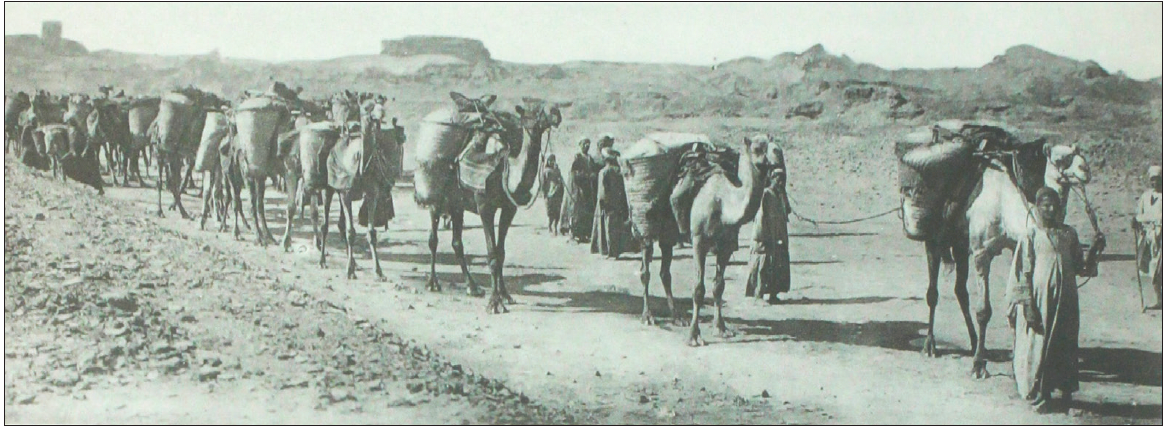
Camels carrying sibākh from Aly Bahgat’s excavations at Fustat (Bahgat and Gabriel 1921, plate II).
For archaeologists, the consequences could be severe. At Ashmunein, ancient Hermopolis Magna, the removal of upper deposits affected the remains of late Roman and medieval occupation so extensively that the history of the site itself became more difficult to reconstruct. Similar problems occurred elsewhere. The issue was not simply that individual objects had been removed, but that entire archaeological contexts could disappear.
When Greg Williams and I looked more closely at this practice, however, it became clear that sibākh digging had a much longer history. Medieval agricultural texts already describe the use of material from ruins as fertilizer.
One source divides fertilizers broadly into two types. The first was based on dung—horse, mule, donkey, and sheep manure—along with human waste, pigeon droppings, and cinders from rubbish burned in public baths. The second was a compost made from materials such as grass, straw, and dung. Significantly, it could also include the “earth of old ruined buildings.”
Other medieval agricultural writings describe comparable practices. The earth accumulated around ruins and rubbish heaps was therefore not simply waste or abandoned material. It had a recognized agricultural use.
This fits into a broader pattern in medieval Cairo and Fustat. Ruined buildings were regularly searched for usable construction material. Stone and brick could be taken from one structure and incorporated into another. During the construction of the khanqah of Baybars al-Jāshankīr, for example, material from earlier buildings was reused. Sources also describe people scavenging the ruins of Fustat for material to build new houses. In some places, this reuse occurred on such a scale that older ruins largely disappeared.
Ruins, then, were not necessarily marginal or useless spaces. They formed part of the working landscape of the city. They could be bought, quarried, reused, inhabited, or mined for fertile earth.
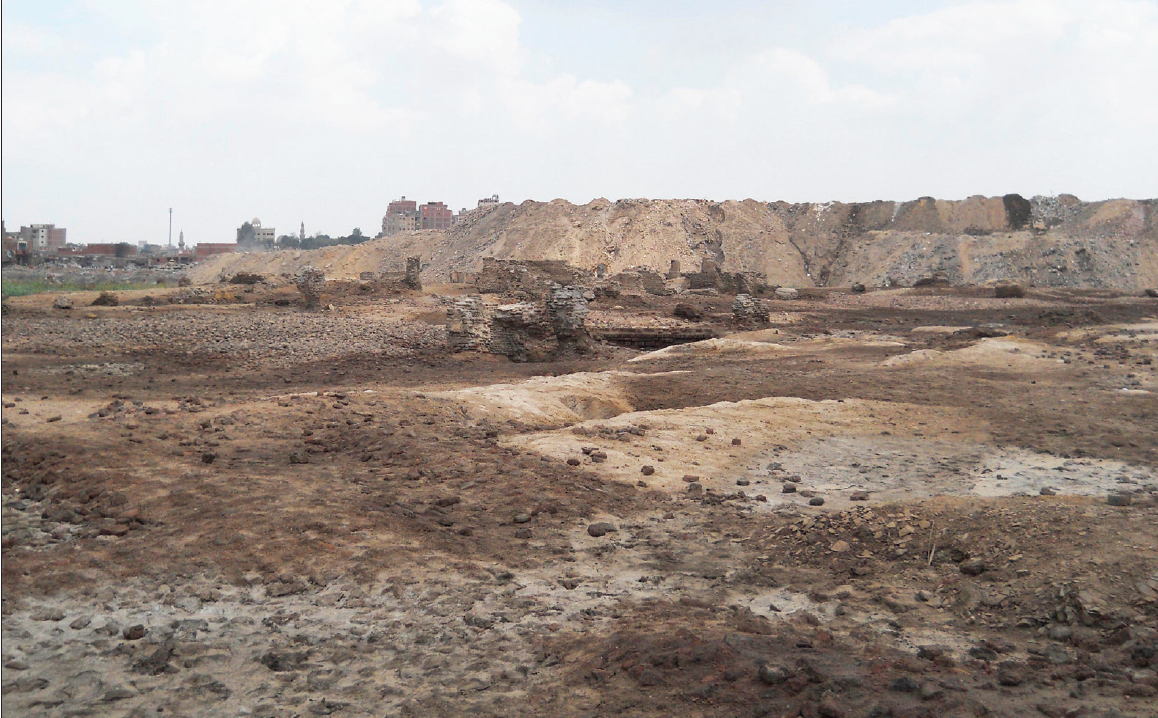
The archaeological zone of Fustat in 2015 (photo by Gregory Williams).
What interests me about sibākh is the way it complicates how we think about both ruins and archaeological absence.
There is a tendency to treat a ruin as the end point of a building’s history. A structure is built, used, abandoned, and eventually becomes an archaeological site. But this is rarely the end of the material story. Buildings can become sources of stone. Mud brick can collapse into sediment. Rubbish and other debris can accumulate over it. That earth can later be removed and used elsewhere. The material remains in circulation even as the historical evidence changes form. This matters because archaeological absence is not always evidence of historical absence.
At some Egyptian sites, the uppermost archaeological layers—the very layers most likely to contain late antique and medieval remains—were also those most accessible to people digging for fertilizer. If these deposits were removed, then later occupation could appear much thinner than it actually had been.
In other words, part of the problem of studying medieval Egypt archaeologically may derive from what people in later periods did with the remains of that medieval landscape. This is one reason I continue to find material history useful. Following the life of a material can reveal connections that conventional historical categories tend to separate: agriculture and archaeology, city and countryside, ruin and resource, medieval practice and modern scholarship.
The ruins did not simply disappear. Some of them became fertilizer enriching fields, crops, and the bodies that consumed them.
This piece draws on research carried out with Gregory Williams and published as “In Search of Sibākh: Digging Up Egypt from Antiquity to the Present Day,” Journal of Islamic Archaeology 3.1 (2016): 89–108.